What is PLC and How it works?

A PLC (Programmable Logic Controller) is an industrial computer used to automate machines and equipments by taking input signals, process them using a program and grenerate appropriate output signals.

The full name of the PLC is Programmable Logic Controller and it is a computer that helps in automating the industries. You can understand it by its name also as Programmable means ability of re-programming , Logic means set of instructions that are written with the help of software and last word is Controller means – Hardware device that provides the structure so that we get the required output from. PLC normally takes the input signal from the input device and process it by CPU module then provide a  output signal.

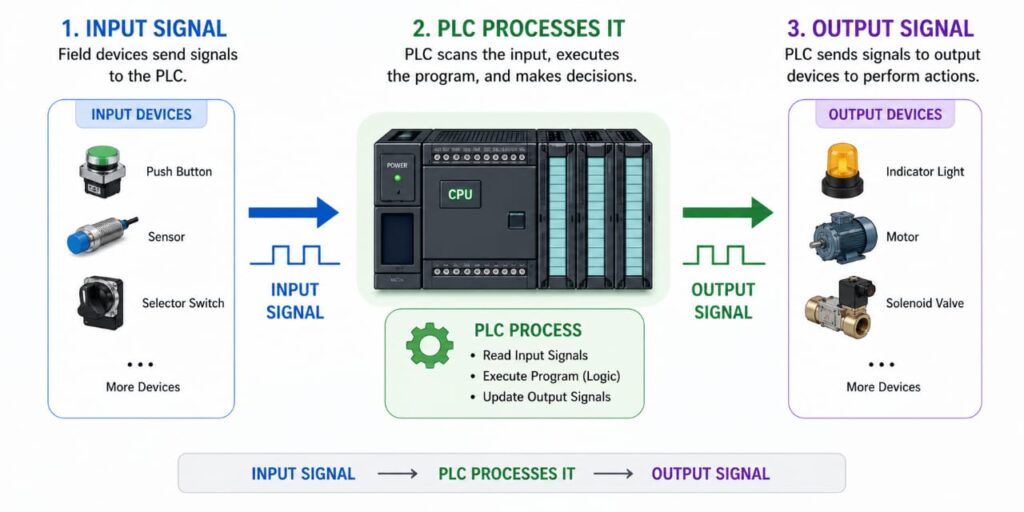
How PLC Works diagram

Here you can easily understand that how plc generates an output. 

  • Step-1: Input Signal Received.
  • Step-2 : Input Module Processes Signal.
  • Step-3 : CPU Executes program.
  • Step- 4 : Output Signal Generated and output device operates through output module.

When plc generates a output signal then we can operate the different types of output devices like lamps, solenoids, motor, etc. Output signal will depend upon the wiring of the plc because there are two methods are available as PNP & NPN.

How PLC Works (Step by Step Process)

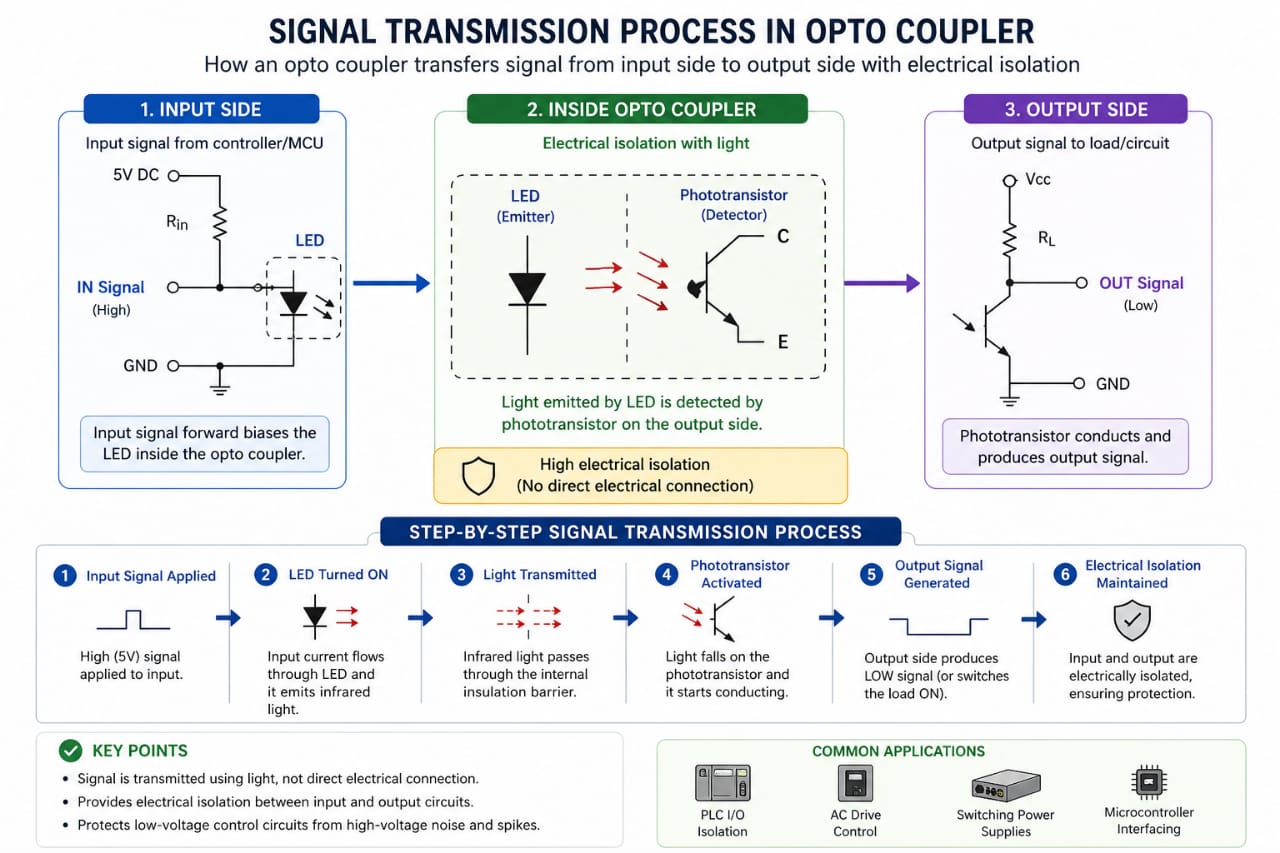
How PLC transmits a signal inside process.

PLC transmits a signal by opto-coupler( emitter led and receiver)

  1. Input Signal: PLC CPU sends a low-voltage DC signal.
  2.  Internal LED: This signal flows into a small internal LED, turning it on.
  3. Optical Transmission: The LED emits infrared light which travels across a tiny, transparent insulating barrier inside the IC package.
  4. Photo-sensitive Device: On the output side of the barrier, a photosensitive component (e.g., a phototransistor, photodiode, or photo-triac) detects the light.
  5. Output Activation: The light causes the phototransistor to turn ON, allowing the 24V field current to pass through and energize the external device.

Basic Components Of a PLC System.

These are the basic components of a PLC Unit. This Combination generates output when a input signal is given by input devices.

  • Mounting 
  • Power Supply
  • CPU(Central Processing Unit)
  • Input Module 
  • Output Module
  1. Power Supply – Power Supply Unit provides the power to each plc module and CPU also.
  2. CPU Module –  This module is the brain of the Programmable Logic Controller(PLC). It reads the input signal perform calculations and process the output signal according to the logic and update it on output module.
  3. Input Module – In this module input devices are connected through this module CPU reads the input signal and provide appropriate output signal.
  4. Output Module – Output devices are connected to this module, when an output signal received by CPU it transfer the voltage to the output devices (like- solenoid valves, lamps, motors, relays, etc).  
  5.Mounting – Mounting are the device in which all system is mounted. 

Types OF PLCs

We can differentiate PLC types in different aspect but we will understand only general and mosted used types that are based on the design of the PLC.

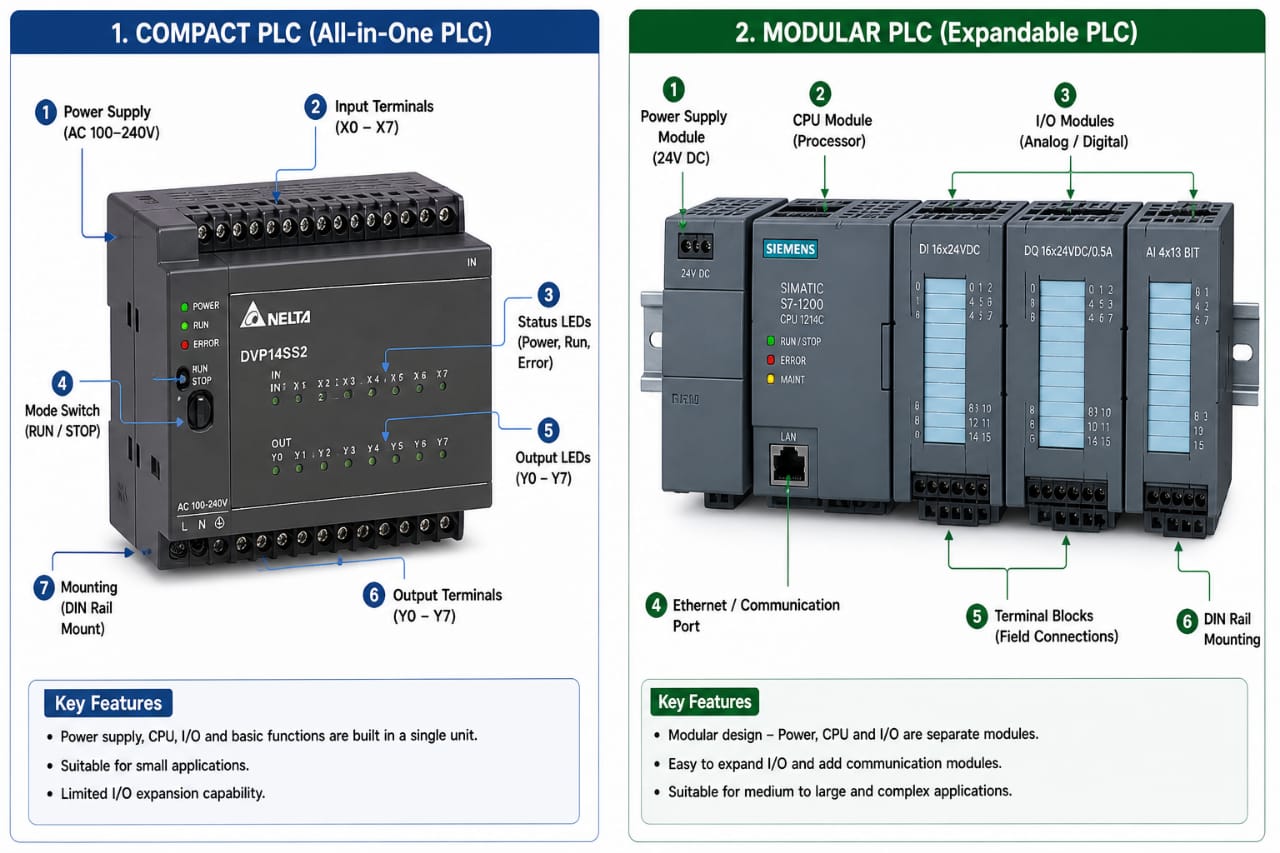
  1. Fixed (Compact / Integrated PLC)
  2. Modular PLC

types of plc

Now we will understand the each type in easy language.

  1. Fixed (Compact/Integrated PLC) – Compact PLCs are the PLCs in which each module is fixed on the micro controller (like Input module, Output module, etc). In this types we get the fixed number of inputs and outputs that are predefined by the maker and we can not expand it.

Example -> FX- Series PLCs (Mitsubishi Electric) ; S7-1200 (Siemens) ; Micro800/CompactLogix (Bradley/Rockwell Automation) , etc.

2. Modular PLC – Each Module is mounted individually on the base rack in Modular types of PLCs . This allows us expand the number of input and output devices connect according to the requirement of the modules and different types of card we can use by using this types of PLCs.

Ex- Q & R-series (Mitsubishi Electric) ; SIMATIC S7-1500 (Siemens)

PLC Working Principle (Scan Cycle).

A PLC works continuously by repeating a process called the scan cycle. In this cycle, the controller first reads all input signals such as switches and sensors. Then, it processes these inputs using the programmed logic stored in its memory. After processing, the PLC updates the output devices like motors, lamps, or valves based on the result. Finally, it performs internal checks and communication tasks before starting the next cycle. PLC Scan Cycle
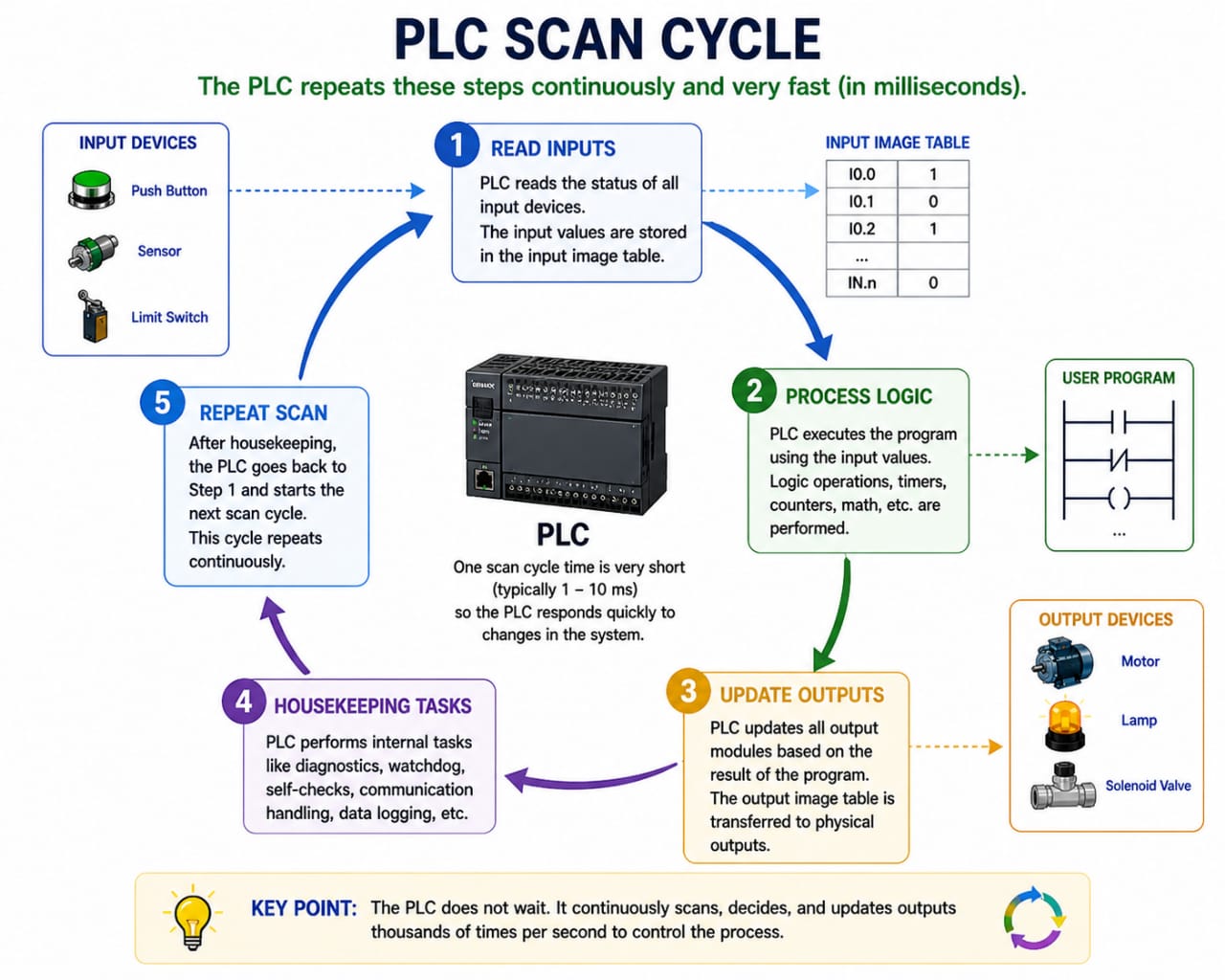
 

  • PLC reads inputs
  • Execute Program
  • Update Outputs
  • Repeat 

This entire sequence happens very fast (in milliseconds), allowing the PLC to respond quickly to changes in the system and control industrial processes efficiently. 

PLC Scan Time – Time taken during processing  the whole process is called PLC Scan time. This time can  be varry on these factors.

  • Number of input and outputs
  • Length of Logic
  • Loops Pids
  • Highspeed data
Generally this time lies between 0.1 millseconds upto 50 milliseconds.

Types Of Languages for PLC.

  • Ladder Logic
  • FBD (Functional Block Diagram)
  • SFC
  • SCL
  • IE/IL
Mostly ladder logic is used widely.
 

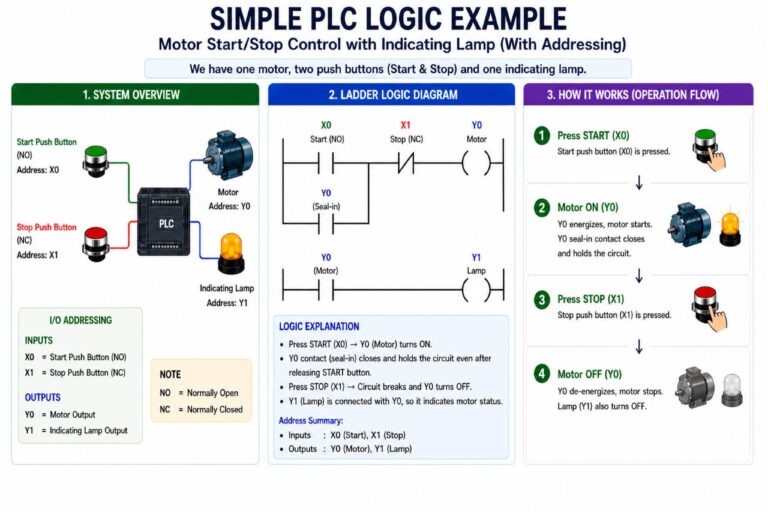
Simple Example to Understand the working of PLC.

IF  we have to on the motor by a push button and its indication should be on by a indicating lap after the motor starts.

Simple PLC LOGIC Example
  •  Input devices- A Green Pushbutton (X0), Red Pushbutton (X1)
  • Output devices- A motor and Indication lamp.

When we Press Green push button(X0) –> MOTOR (Y0) will On then after Indication lamp will be on. But When we we will push the Red Push button—> motor will be OFF then lamp also.

Advantages and Disadvantages Of PLC.

PLCs are powerful and reliable devices that used for automations. Here are some advantages and disadvantages of PLCs-

Advantages-

  • Less wiring
  • Fast and flexile 
  • Reliable
  • Easy troubleshooting
  • Compact size
  • Easy to program and modify
Disadvantages-
  • Higher Initial Cost
  • Dependence on Software
  • Risk Of System failure
  • Reuires on Basic Training.
 

Tips to learn PLC Easily.

  • Start with basics like hardware understanding and logic flow also.
  • Practice daily during learning journey.
  • Use Simulation Softwaes (like Mitsubishi GX WORKS, Siemens TIA Portal,etc.)
  • Practice with real life examples.


FAQs

1. What is PLC ? 

PLC (Programmable Logic Controller) is an industrial computer used to automate machines and equipments. 

2. What is the Scan time in PLC system ?

Time taken by PLC to read the input signals and processing and solving the logic and generating a output is called plc scan time. It is generally lies  between 0.1 milli-second upto 50 milli-seconds.

3. What is the difference between PLC and relay control ? 

PLC uses software -based logic, while relay control uses physical wiring. PLC Systems are more flexible, less wiring requirement and are easier to modify.

4. Where PLCs are Used?

PLCs are used in industries for automatic the process like-

  • Manufacturing Plants
  • Conveyor systems
  • Traffic Control Systems
  • Water treatment pants

Leave a Comment

Your email address will not be published. Required fields are marked *

Shopping Cart